
AI Productivity for Solopreneurs: Faster Work, Messier Systems

Better tools can help you produce more than ever. Without a system underneath them, they can also give you more to manage.
AI has removed a remarkable amount of friction from solo work. You can research an unfamiliar subject in minutes, draft content in seconds, summarise documents, analyse information, brainstorm ideas, improve emails, create images and work through problems without needing another person in the room.
For someone running a business alone, that is enormously useful. The possibilities for AI productivity for solopreneurs are expanding quickly, but there is a strange consequence: the easier it becomes to create, the easier it becomes to create more. More drafts, ideas, research, notes, content and possibilities. More things get started because the cost of starting them has collapsed.
AI can make an individual task dramatically faster without making the business around that task any easier to manage. As our ability to produce increases, the productivity problem begins to change from How can I get more done? to How do I keep everything I'm doing organised, connected and useful?
At a glance
AI is rapidly increasing the amount of work one person can produce.
Faster output does not automatically create a better-organised business.
Solo operators are increasingly working across AI tools, apps, documents and disconnected information.
The next productivity advantage may come from better systems, not simply more powerful tools.
AI becomes considerably more useful when its output has somewhere structured to go.
AI productivity for solopreneurs is changing the problem
The adoption numbers are already substantial. According to the UK Business Data Survey 2026, 40% of sole traders handling digitised data reported using AI-based technologies, with the figure rising slightly to 41% among microbusinesses.
The more interesting numbers, however, concern what happens after adoption. Among businesses already using AI, only 18% of sole traders said their AI tools were integrated into their existing business systems. For microbusinesses, the figure was 27%.
The OECD is seeing something similar internationally. Its 2026 Digital for SMEs research found AI adoption growing rapidly while strategic integration into business operations remained uneven. Among the SMEs surveyed that were using AI, 76% were classified as AI “novices”, typically relying on simple, off-the-shelf tools for isolated tasks.
There is an important distinction here. Opening an AI assistant and asking it to research a subject, draft something or analyse information is easy. Integrating that capability into a way of working where the output connects to a project, client, publishing workflow, decision, metric or piece of business knowledge is something else entirely.
AI adoption and AI integration are not the same thing.
Faster tasks do not automatically create a better operation
Imagine you run a solo consultancy. You use AI to research a prospect and then ask it to help draft an outline for a proposal. During the research, you spot an interesting idea that could become a piece of content, so you use AI to develop it and create several social posts. Later, you analyse some performance data and discover something useful enough to influence your next campaign.
Individually, AI has accelerated almost every stage of that process. Collectively, however, all of that activity creates new organisational demands. The prospect might be stored in a CRM, the proposal in a document, the content idea inside an AI conversation, the social posts somewhere else and the campaign itself in a project management tool. The performance data remains inside an analytics platform, while the useful lesson you discovered may never leave your head.
The individual tasks became easier, but the overall operation did not necessarily become clearer.
This is where productivity can become deceptive. We naturally notice that something which previously took two hours now takes twenty minutes. We are much less likely to notice the accumulating cost of keeping all the resulting information, decisions and work organised.
More output creates more organisational responsibility
Before generative AI, producing something substantial usually imposed its own limit. Writing took time, research took time and creating multiple viable options took time. Those constraints naturally restricted how much material one person could produce.
Now one person can generate twenty ideas in the time it might previously have taken to develop five. That sounds like an uncomplicated productivity win, but those twenty ideas also become twenty things requiring judgement. You still have to decide which are worth pursuing, whether something similar already exists, where each useful idea belongs and what should happen next.
The bottleneck therefore begins to move away from production and towards coordination, judgement and organisation. Producing more only becomes valuable when we can make sensible decisions about what we have produced.
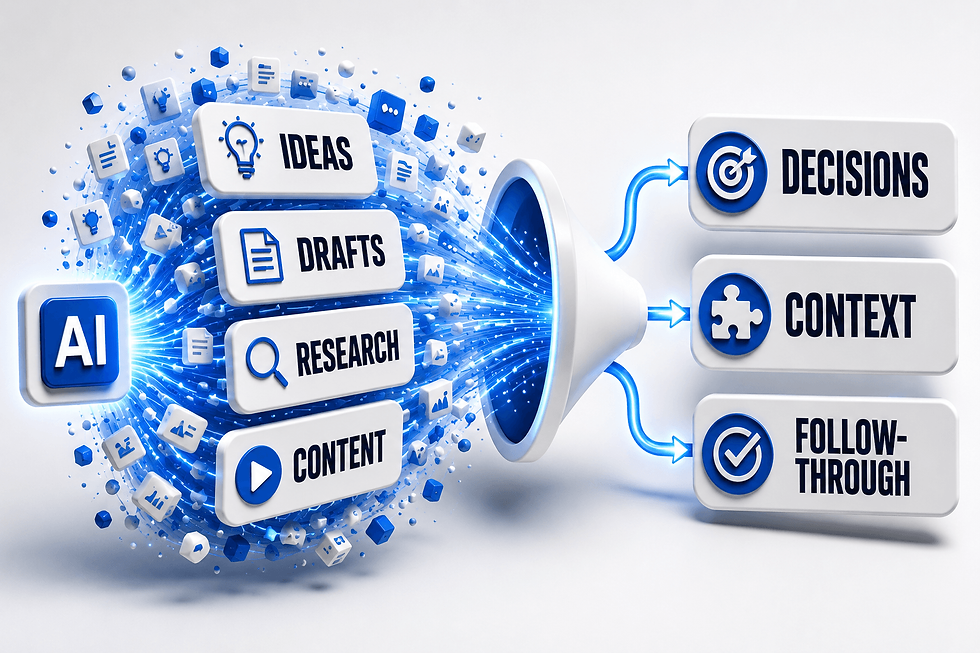
This is why simply adding more AI tools to your working life can eventually become counterproductive. Every new capability can create another stream of information and another place where work begins. AI reduces the cost of creating work, but it does not remove the responsibility of managing it.
Tool overload was already a problem
AI did not create fragmented digital work. For years, solo professionals have assembled their businesses from whichever tools solved the immediate problem: one application for projects, another for notes, perhaps a spreadsheet for money and a CRM for clients. Analytics remain inside platform dashboards, strategy accumulates in documents, publishing is organised through calendars, and useful research disappears into bookmarks.
Then AI arrived as another extraordinarily capable layer across all of it.
None of those tools is necessarily the problem. Specialist software can be excellent at what it does, and there is little value in replacing a good tool simply for the sake of having fewer applications.
The problem appears when you become the integration layer.
You are the person who has to remember where information lives, what relates to what, which version is current, where something should go next and whether the useful thing you captured three months ago still exists somewhere. That is cognitive work too, even though it rarely appears on a task list.
The more capable our individual tools become, the easier it is to overlook the growing amount of invisible work required to hold everything together.
The answer isn't necessarily fewer tools
There is a tempting response to tool overload: delete everything and find one application that does it all. For most businesses, that is neither necessary nor particularly realistic.
Your accounting software probably should remain accounting software. Your email platform has a specific job. Analytics platforms hold information that cannot simply be relocated, and AI itself will continue to exist across multiple services. A useful business system does not need to replace every specialist tool you use.
A better question is: where does the operational truth of your work live?
You need somewhere that allows you to understand what you are working on, what requires attention, what belongs together and what happened as a result. That is the difference between accumulating tools and building a system.
A good system does not have to perform every task itself. Its job is to provide enough structure and connection that the tasks stop feeling like unrelated pieces of work scattered across your digital life.
A good system gives AI somewhere to land
This becomes increasingly important as AI produces more useful material. Suppose an AI conversation gives you an excellent insight about your audience. If that insight remains buried inside the conversation, you successfully generated knowledge but failed to operationalise it. If it enters a structured knowledge system, connects to the relevant content or project and remains available when you make a future decision, its value extends well beyond the original prompt.
The same principle applies throughout a business. Ideas need a route into actual work, while projects need context and clear next actions. Client activity becomes more useful when there is a history behind it. Revenue tells us more when we can understand what produced it, and performance data becomes valuable when it influences what we do next. Knowledge, meanwhile, needs to remain findable long after the moment in which it was captured.
AI can contribute at almost every stage of that process. Structure is what allows those contributions to survive beyond the conversation in which they were generated.

The six-question system test
You do not need to rebuild your working life every time a new technology appears. It is worth asking, however, whether your current setup can comfortably handle the amount of work modern tools allow you to create.
Can I see my active work without searching through several different places?
Can I quickly tell what needs my attention next?
Can I connect work to the project, client or objective it belongs to?
When I capture something useful, can I reliably find it again?
Can I see the outcomes of my work, rather than only the tasks I completed?
If AI generates something valuable today, do I know where it belongs tomorrow?
You do not need perfect answers to all six. But if several of them produce some variation of “I keep that in my head” or “I know it's somewhere”, your limiting factor may no longer be your ability to get things done. It may be the infrastructure supporting the work.
Build the operating layer before chasing the next tool
There will always be another productivity app, and there will certainly be another AI tool. Some will be genuinely transformative; others will enjoy six months of attention before something newer replaces them.
Building your entire way of working around whichever tool currently feels most exciting means repeatedly rebuilding the same foundations. A more durable approach is to establish the operating layer first: how projects enter your system, where tasks belong, how client information connects to delivery, how content moves from idea to publication, where important knowledge lives and how results feed back into future decisions.
Once those foundations exist, adopting useful new technology becomes easier rather than harder. The new tool does not have to become your new way of working; it simply has to contribute something useful to the way of working you already have.
Why we built BrainyStack Pro around connected work
This problem influenced how we built BrainyStack Pro OS. Rather than creating another collection of isolated productivity templates, we built one operating environment where projects, content, clients, finance, analytics and business knowledge remain distinct parts of the business while still belonging to the same wider system.
AI does not replace that structure. If anything, its rapid development makes the structure more useful. When our tools allow us to create and process more information than ever before, knowing where that information belongs and what should happen to it becomes increasingly important.
It is also why we believe productivity systems should feel more like good software: predictable enough that you can use them without constantly having to think about how they work.
The productivity advantage is moving
For years, digital productivity was largely about finding tools that could help us do things faster. That problem has not disappeared, but AI is changing its importance.
When almost anyone can draft, research, brainstorm, summarise and generate at extraordinary speed, raw output becomes less of an advantage by itself. The greater advantage lies in deciding what deserves to exist, keeping useful work connected, preserving context and turning information into action.
AI gives solo operators capabilities that would have seemed extraordinary only a few years ago, and there is every reason to take advantage of them. But increased capability also makes the systems underneath our work more important, not less.
Better tools increase your capacity. Better systems help you control it.
Comments